Fly Eagle Sport

Frequently Asked Questions

Real answers to the most common questions about flight training, discovery flights, pricing, and what it's actually like to learn to fly at KGEU.
Discovery Flights

What is a Discovery Flight?
A Discovery Flight is a one-hour introductory flight with one of our Certified Flight Instructors (CFIs). You'll do a pre-flight walk-around of the Remos GX, then take off and take the controls in the air. The CFI handles all radio communications and is in command at all times — your job is to fly and experience what training actually feels like. No experience or prior knowledge is needed. It's the best way to decide whether you want to pursue a certificate.
How much does a Discovery Flight cost?
$160. That covers one hour in the Remos GX with a CFI — pre-flight briefing, the full flight, and a debrief afterward. No commitment to enroll in training, and no hidden fees. If you decide you want to start training after the flight, your Discovery Flight time can count toward your logbook.
Do I need any experience to take a Discovery Flight?
None at all. Discovery Flights are designed specifically for people who have never been in a cockpit. You don't need to study anything beforehand. Just show up, be comfortable, and we'll handle everything else.
Can I bring someone with me to the Discovery Flight?
Absolutely. Family members or friends are welcome to come to the airport and watch from the ground. The Remos GX is a two-seat aircraft, so only you and the instructor will be in the cockpit — but there's a viewing area at KGEU and your guests can be there for the briefing and see you taxi out. It makes for a great shared experience.
What is the minimum age for a Discovery Flight?
The minimum age for a Discovery Flight at Fly Eagle Sport is 14. Passengers under 18 must have a parent or guardian present to sign a waiver before the flight. The FAA minimum age for solo flight is 14 for glider students, 16 for Sport Pilot (powered aircraft) and Private Pilot students. There is no maximum age — we've flown with students in their 60s and 70s earning their first certificate.

Programs & Certificates

What is the difference between Sport Pilot and Private Pilot?
Sport Pilot is faster and more affordable — minimum 20 hours (most students take 35–40), and you only need a valid driver's license instead of an FAA medical. The tradeoff is that Sport Pilot limits you to Light Sport Aircraft, daytime VFR flying, and one passenger. Private Pilot takes more hours (minimum 40, average 60–70) and requires an FAA medical, but gives you far more freedom: fly at night, carry multiple passengers, fly a wider range of aircraft, and build toward advanced ratings. Our Pilot's Guide covers both options in detail.
How long does it take to earn a pilot's license?
Students who fly 2–3 times per week in Arizona typically earn a Sport Pilot Certificate in 2–4 months and a Private Pilot Certificate in 3–6 months. Gaps between lessons slow you down significantly — aviation skills need to stay current. One of the best things about training in Arizona is that our 350+ VFR days mean there are almost no weather-forced delays.
Do you train students for commercial and airline careers?
Yes. We offer the full career-track path: Private Pilot, Instrument Rating, Commercial Pilot, and CFI. For pilots who already hold a certificate and need to build flight hours toward ATP minimums (1,500 hours), our Time Builder Packages offer bulk hours in the Remos GX at reduced rates.
What is the path from zero experience to airline pilot?
The standard path is: Private Pilot Certificate → Instrument Rating → Commercial Pilot Certificate → CFI Certificate → build 1,500 total flight hours (required for airline employment under Part 121 regulations) → apply to regional airlines. Most pilots use CFI work to build hours efficiently. Fly Eagle Sport trains students through the Commercial level and CFI, and our Time Builder Packages help accelerate the hour-building phase.

Medical Requirements

Do I need a medical certificate to fly?
It depends on what certificate you're pursuing. Sport Pilot students only need a valid U.S. driver's license — no FAA medical exam required. Private Pilot students and above need at least a Third-Class FAA Medical Certificate from an Aviation Medical Examiner (AME). Commercial Pilot candidates need a Second-Class medical. If you have health concerns, talk to us before assuming you can't fly — there may be a path forward through Sport Pilot, BasicMed, or an FAA Special Issuance.
I have a medical condition — can I still learn to fly?
Possibly yes. Many conditions that were once considered disqualifying are now manageable through FAA Special Issuance certificates, the BasicMed program, or the Sport Pilot pathway (which uses driver's license medical standards). The AOPA Medical Certification team offers free assistance at aopa.org/medical. We recommend consulting them before ruling out flying based on a medical history.
What is BasicMed?
BasicMed is an FAA alternative to the traditional Third-Class medical certificate. If you've held a valid FAA medical at any time since July 14, 2006, you may be eligible for BasicMed. Under BasicMed, your regular physician performs a physical exam using a standardized checklist, and you complete an FAA online course. It allows you to fly most general aviation aircraft under certain conditions without a traditional AME exam. Ask us if BasicMed applies to your situation.

Pricing & Packages

What are your aircraft rental rates?
All aircraft rent at wet rates — fuel is included in the hourly price. Remos GX: $140/hr. Sonex: $150/hr. AirCam: $200/hr. Instructor fees are billed separately. See our full pricing page for current rates, bulk packages, and CFI fees.
What does "wet rate" mean?
A "wet" rate means fuel is included in the hourly rental price. You pay the posted hourly rate and nothing additional for the fuel you burn. This is the standard at Fly Eagle Sport and makes it easy to budget your training costs accurately — no surprises at the pump.
Do you offer bulk hour packages for time builders?
Yes. Our Time Builder Packages are available in 35, 50, and 100-hour blocks in the Remos GX, at reduced per-hour rates compared to booking individually. These are designed for pilots who already hold a certificate and are building toward Commercial or ATP minimums. See the Time Builder Packages page for current pricing and package details.

Aircraft & Training

What aircraft will I train in?
Most students train in the Remos GX — a modern Light Sport Aircraft (LSA) with glass-panel avionics, a reliable Rotax 912ULS engine, and excellent handling for student pilots. It's a great platform that builds real skills in a capable, well-equipped aircraft. We also operate the AirCam and Sonex for specialized programs.
What is a Light Sport Aircraft (LSA)?
A Light Sport Aircraft is a category of FAA-defined aircraft with specific weight and performance limits — generally a max takeoff weight of 1,320 lbs for land planes, max airspeed of 120 knots, and a maximum of two seats. LSAs are simpler and more affordable to operate than traditional training aircraft, and they qualify for Sport Pilot training. The Remos GX is a certified LSA with modern avionics and a Rotax engine — not a dated or basic training aircraft.
Do you have flight simulators?
Yes — we have a Redbird LD FAA-certified Advanced Aviation Training Device (AATD) on site, housed in its own private room at KGEU. This isn't a consumer-grade sim. It's a fixed-base, FAA-certified AATD with a wrap-around visual system, 6-pack avionics with IFR GPS, and full ForeFlight/iPad compatibility — the same category of device used by professional flight schools nationwide.

Hours logged in the Redbird count toward your actual certificate requirements: up to 2.5 hours toward your Private Pilot, up to 20 hours toward your Instrument Rating (with a CFI), and up to 50 cumulative hours toward your Commercial. At $70/hr — compared to $140/hr in the aircraft — the savings add up fast.

The Redbird is also available for solo sessions after an initial one-hour checkout with an instructor, making it easy to practice approaches, holds, emergency procedures, and radio communications on your own schedule. Membership plans and block-time packages are available. Learn more on the Redbird page →

Weather & Scheduling

What happens if my flight gets cancelled due to weather?
We don't charge for flights cancelled due to weather. If conditions aren't safe or appropriate for your current training level, your instructor will reschedule at no cost to you. In Arizona, this happens far less often than in most of the country — but when it does, your safety and training quality always come first.
Can I fly during Arizona summer? It gets very hot.
Yes, with appropriate planning. Most Arizona pilots fly early morning during summer (takeoff by 7–9 a.m.) to take advantage of cooler air, better aircraft performance, and smoother conditions. Your instructor will teach you to calculate density altitude and account for heat's effect on performance — skills that make you a more safety-conscious pilot anywhere you fly. Many of our students are early morning flyers year-round and find the Arizona summer schedule completely workable.
What about monsoon season?
Arizona's monsoon season runs July through September, bringing afternoon and evening thunderstorms — sometimes building very quickly. Morning flying is typically excellent during monsoon season; it's the afternoons and evenings that become unpredictable. Your instructor will teach you to read convective weather, understand storm development timelines, and make smart go/no-go decisions. Training through monsoon season builds some of the best weather-awareness skills in general aviation.

About Fly Eagle Sport

Where are you located?
We're at Glendale Regional Airport (KGEU), 6635 N Glen Harbor Blvd, Glendale, AZ 85307. KGEU is in the northwest Phoenix metro, easily accessible from Glendale, Peoria, Surprise, Goodyear, Avondale, and central Phoenix. Call us at 602-899-2028 if you need directions.
Is Fly Eagle Sport veteran-friendly?
Yes. Fly Eagle Sport was founded by an active Arizona Army National Guard aviator, and both of our founders continue to serve. We understand military culture, non-traditional schedules, and the transition from military to civilian aviation. If you're a veteran, active duty, or Guard/Reserve member — whether you're starting from scratch or translating military aviation experience to civilian certificates — we'd love to connect.
How do I get started or schedule a flight?
The easiest way is to fill out our contact form or call us at 602-899-2028. We'll get back to you quickly, answer any questions, and get a Discovery Flight or training appointment scheduled. Most Discovery Flights can be set up within a few days of first contact.
Do you have your own maintenance team?
Yes. We have an A&P (Airframe and Powerplant) mechanic on staff. In-house maintenance means our aircraft are serviced by people who know them specifically — not sent out to a third-party shop. When an aircraft comes out of maintenance, the person who worked on it is down the hall. We consider this a meaningful safety and reliability advantage.
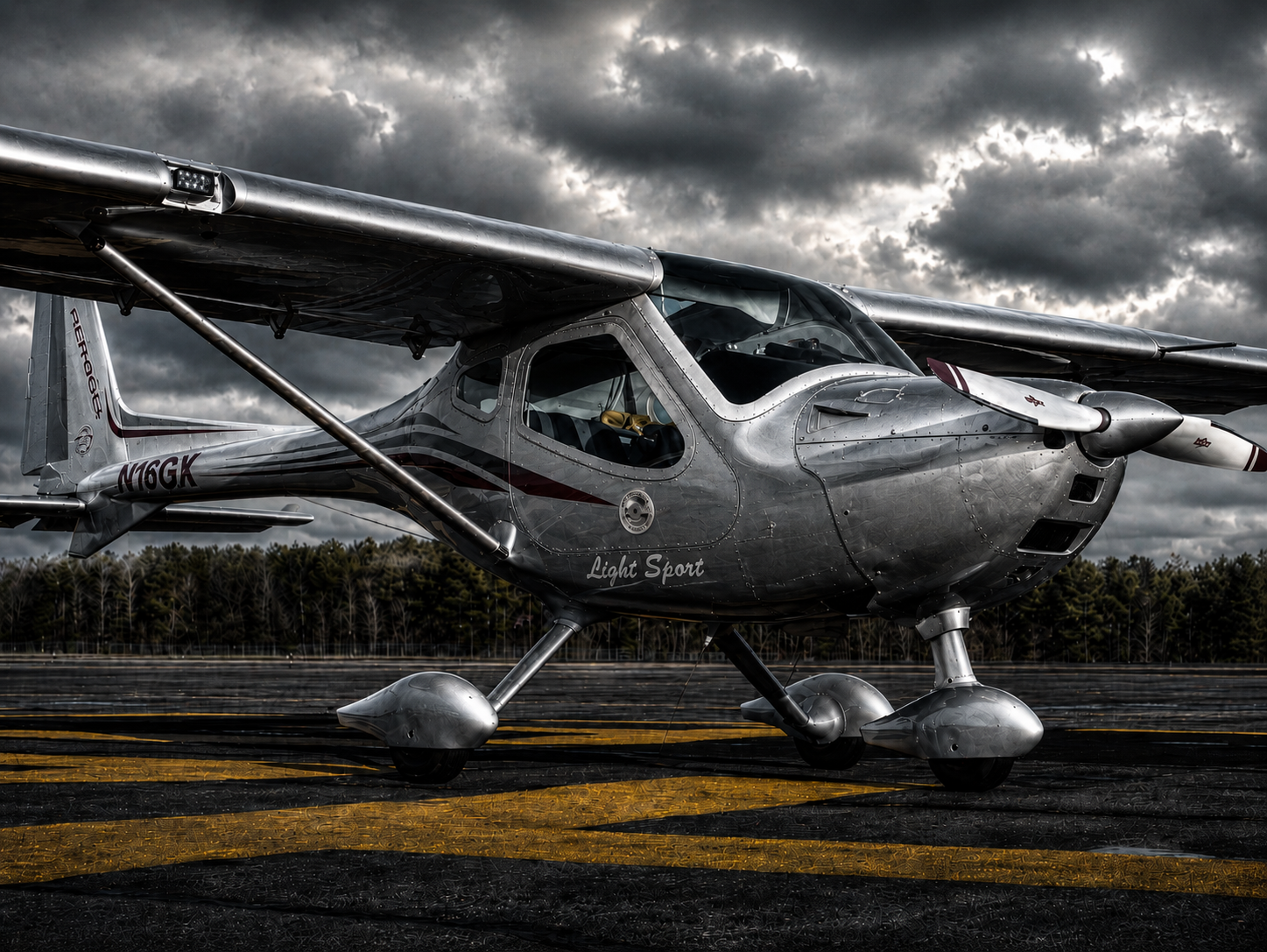
Remos GX — Fly Eagle Sport training aircraft

Still Have Questions?

Real Answers — Faster Than You'd Expect

When you call FES, you'll be greeted by Sam — our advanced AI assistant who can answer most questions about programs, pricing, scheduling, and aircraft on the spot. Sam isn't a phone tree or a hold queue. He's genuinely helpful, and taking a moment to tell him exactly what you're looking for is worth it.

Here's why: Sam routes your call to the right person — whether that's a CFI, an admin, or our maintenance team — so when we call you back (usually within minutes), it's the right conversation from the first word. No getting bounced around. No repeating yourself.

Prefer to leave a message? Just say so and Sam will take it. We'll return your call promptly. You can also reach us by email or through the contact form below — every message is read by our team at KGEU.